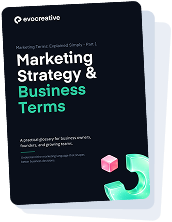
Marketing terminology can be useful, but it can also create confusion. Terms like positioning, ICP, demand generation, CAC, funnel, and GTM are used all the time, but not always clearly. This guide explains the foundational marketing strategy and business terms that often come up when planning a website, brand, campaign, or growth strategy.
This page includes a selection of key marketing strategy and business terms to help you quickly understand the language behind better marketing decisions. For the complete glossary, including additional terms, examples, and common mistakes, download the full PDF guide.
Why We Created This Guide
Marketing has a language problem.
Many terms are useful, but they are often used loosely. A "lead" may mean one thing to sales and another thing to marketing. "Brand" may mean a logo to one person and reputation to another. A "strategy" may become a list of tactics instead of a clear direction.
That lack of clarity can lead to weak briefs, vague proposals, poor expectations, and marketing decisions that are harder than they need to be.
This glossary was created to make marketing strategy language easier to understand and apply.
Who This Guide Is For
Business owners trying to make better marketing decisions
Founders preparing to invest in branding, websites, content, or campaigns
Marketing managers who want clearer shared language with leadership or sales
Sales or operations leaders involved in marketing conversations
Anyone tired of vague jargon and unclear explanations
How to Use This Glossary
You do not need to read this glossary from top to bottom. Use it as a reference when you come across a term in a proposal, meeting, report, or campaign discussion.
Each definition should be practical, not academic, so readers can quickly understand what the term means and why it matters.
Marketing Strategy & Business Glossary
Marketing terms are most useful when they help you make better decisions. These definitions are written to be practical, not academic, so you can quickly understand what each term means and why it matters.
Brand & Positioning
Why it matters
Your brand influences trust, pricing power, and customer loyalty. It's not what you say about yourself—it's what others say and feel about you.
Example
A strong brand allows premium pricing and customer loyalty even when competitors offer similar products.
Why it matters
Your brand influences trust, pricing power, and customer loyalty. It's not what you say about yourself—it's what others say and feel about you.
Example
Creating a new website with cohesive visual identity and clear messaging is branding work that shapes your brand.
Why it matters
Clear positioning helps customers understand why they should choose you over alternatives. It's the foundation for effective messaging.
Example
Positioning as 'the fastest enterprise CRM for remote teams' is more specific than 'a great CRM solution.'
Why it matters
Messaging translates positioning into words. It's how you explain what you do, who it's for, and why it matters.
Example
Your homepage headline, value proposition, and feature descriptions are all messaging components.
Why it matters
A strong value proposition immediately communicates what makes you worth choosing. It focuses on customer outcomes, not just features.
Example
'Cut customer onboarding time by 50%' is stronger than 'Advanced automation features.'
Strategy & Planning
Why it matters
Strategy defines what you will and won't do. It's about making trade-offs and focusing resources where they'll have the most impact.
Example
A strategy might be 'build authority through educational content for HR leaders' rather than 'try every marketing channel.'
Why it matters
A plan turns strategy into action. It answers who does what, when, and with what resources.
Example
Your Q3 content calendar with specific blog topics, publication dates, and assigned writers is part of your marketing plan.
Why it matters
A GTM strategy coordinates sales, marketing, and product to ensure a successful launch or market entry.
Example
Launching a new SaaS product with a freemium model, partner integrations, and targeted LinkedIn campaigns is a GTM approach.
Why it matters
Pricing isn't just a number—it's a positioning signal. It affects perception, profitability, and who your customers are.
Example
Premium pricing signals quality and exclusivity, while freemium pricing lowers barriers to trial.
Audience & Market
Why it matters
ICP helps you focus on accounts worth pursuing. It's especially important in B2B where not all customers are equally valuable.
Example
'Series A-funded SaaS companies with 20-100 employees in North America' is an ICP definition.
Why it matters
Personas help you understand individual motivations, pain points, and decision-making criteria. They guide messaging and content.
Example
'Sarah, VP of Marketing at a growth-stage company, budget-conscious, cares about measurable ROI' is a buyer persona.
Why it matters
Segmentation allows personalized marketing. Different segments may need different messaging, offers, or channels.
Example
Segmenting by company size (SMB vs. Enterprise) lets you create content and pricing specific to each group.
Why it matters
Clarity on your target audience prevents wasted effort and ensures messaging resonates with the right people.
Example
'Marketing leaders at B2B SaaS companies preparing for expansion' is more focused than 'businesses that need marketing.'
Funnel & Demand
Why it matters
Understanding the journey helps you create relevant content and experiences at each stage, guiding customers toward conversion.
Example
Awareness → Consideration → Decision → Retention is a simplified customer journey framework.
Why it matters
Demand generation builds the pipeline of future buyers. It's long-term brand building and education.
Example
Publishing thought leadership articles and hosting webinars are demand generation tactics.
Why it matters
Demand capture targets high-intent prospects ready to buy. It drives near-term revenue.
Example
Google Ads targeting 'buy project management software' is demand capture.
Why it matters
Lead generation fills your sales pipeline with prospects who've shown interest and can be nurtured toward purchase.
Example
Offering a free guide in exchange for email signup is a lead generation tactic.
Why it matters
The funnel helps you understand where prospects drop off and where to focus optimization efforts.
Example
Top of funnel (awareness) → Middle of funnel (consideration) → Bottom of funnel (decision).
Revenue & Growth
Why it matters
CAC tells you how much it costs to win a customer. It's critical for understanding profitability and scaling viability.
Example
If you spend $10,000 on marketing and acquire 100 customers, your CAC is $100.
Why it matters
CLV helps justify acquisition costs and prioritize retention. A higher CLV means you can afford higher CAC.
Example
If customers pay $100/month and stay for 24 months on average, CLV is $2,400.
Why it matters
ROI measures marketing effectiveness. It helps justify budgets and prioritize high-performing channels.
Example
A campaign costing $5,000 that generates $20,000 in revenue has a 300% ROI.
Why it matters
KPIs keep teams focused on what matters. They should be specific, measurable, and tied to business outcomes.
Example
Monthly recurring revenue (MRR), conversion rate, and customer churn rate are common SaaS KPIs.
Why it matters
Growth marketing prioritizes measurable results and continuous improvement over traditional campaign-based thinking.
Example
Running A/B tests on signup flows, onboarding emails, and pricing pages to increase activation rates.
Want the complete version?
The downloadable PDF includes the full Marketing Strategy & Business Terms glossary, with additional terms and explanations you can save, share, or use as a reference with your team.
They happen at different stages of the customer journey, so they need different tactics, content, channels, and expectations.
Quick difference
Lead generation captures contact details. Demand generation creates awareness, interest, and trust before someone is ready to buy.
Why it matters
If you treat demand generation as just “getting more leads,” you may measure the wrong things or expect short-term results from long-term brand-building activity.
Quick difference
Your ICP defines the best-fit customer. Your buyer persona describes the person involved in the buying decision.
Why it matters
One helps you choose who to target. The other helps you understand how to communicate with the people inside that target market.
Quick difference
A marketing strategy defines the direction. A marketing plan defines the execution.
Why it matters
Without strategy, a plan becomes a list of disconnected activities. Strategy explains why you are doing something before the plan explains how.
Quick difference
CAC shows how much it costs to acquire a customer. CLV shows how much value a customer brings over time.
Why it matters
Looking at both together helps you understand whether your growth is sustainable, not just whether you are getting new customers
Quick difference
ROI measures the return from an investment. KPIs measure progress toward a specific goal.
Why it matters
Not every KPI is ROI. Metrics like traffic, conversion rate, or email signups may show progress, but they do not automatically prove financial return.
Go Deeper Into These Marketing Terms
We'll be publishing deeper explanations of these commonly confused marketing terms soon. Click on the topics you're interested in and leave your email to be notified when they're ready.
Get notified when this article is ready
No spam. Just practical marketing explanations in plain English.
Frequently Asked Questions
A marketing strategy glossary is a reference guide that defines key marketing terms in practical, plain-English language. Unlike academic dictionaries, this glossary focuses on helping business owners and marketing teams understand how terms apply to real-world decisions like planning campaigns, setting budgets, and evaluating performance.
This glossary is designed for business owners, founders, marketing managers, sales leaders, and anyone involved in marketing conversations who wants clearer shared language. It's especially useful if you're evaluating proposals, briefing projects, or making strategic marketing investments.
Understanding marketing language helps you make better decisions, set clearer expectations, and communicate more effectively with marketing teams or agencies. When everyone speaks the same language, briefs are sharper, proposals are clearer, and marketing investments are more likely to deliver results.
Marketing strategy is the high-level direction and trade-offs that guide your approach—it answers 'what should we focus on and why?' A marketing plan is the specific tactics, timeline, budget, and responsibilities that bring the strategy to life—it answers 'who does what, when, and how?'
Demand generation creates awareness and interest in your category and brand before active purchase intent exists. It's long-term pipeline building. Demand capture targets people already searching for solutions like yours and converts existing intent. Both are essential for balanced growth.
Yes, the PDF version of this glossary is completely free with no form required. It's a practical resource you can download, save, and share with your team.
Marketing Terms Should Create Clarity, Not Confusion
When everyone understands the language, it becomes easier to make better decisions, brief better projects, and build marketing that actually supports the business.